EU Commission Omnibus Article 88b
19 Nov 2025
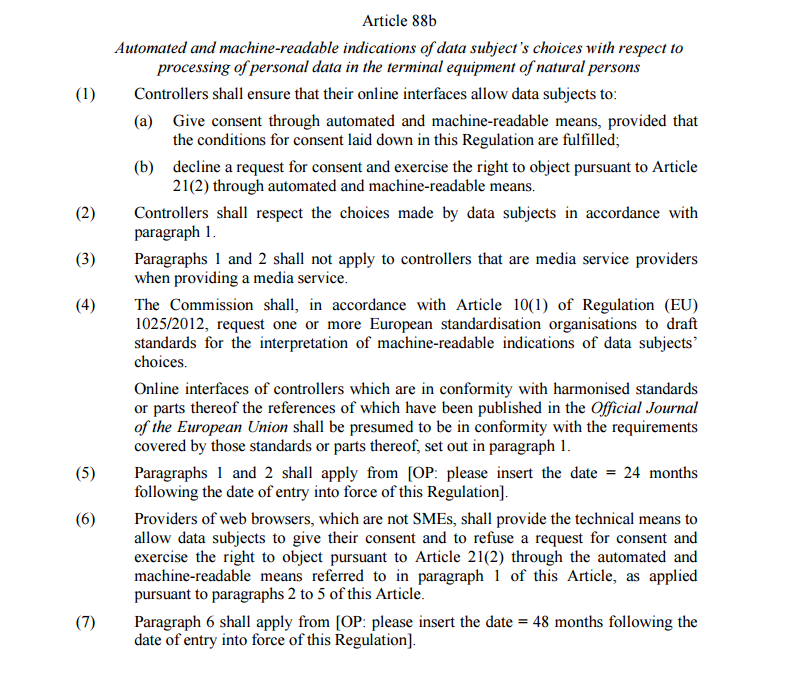
On 19 November 2025, the Omnibus regulation draft released by EU Commission included an Article 88b to be inserted within the GDPR. It requires online human rights to be implementable cross-platforms -e.g. standardisation of a sovereign human-centric digital Tech.
Fun fact is that the European patent office delivered ID side its certificate to the "Personal Data Choices Management Platform" on the 18th. Hence basically making our EU-native tool part of this new reality.
Article 88b introduces a significant step forward, moving beyond mere legal compliance to embedding genuine user choice and control into the very fabric of our online interfaces (a transition from never-ending cookie banners human sovereign web).
It is also a pivotal requirement in practice: websites must provide automated and machine-readable means for users to give, but also to refuse, consent directly. And there are 4 characteristics to match: being verifiable, user-controlled, persistent and technically enforceable privacy preference signals.
At ID side, we see this not just as a future obligation, but as a core principle we've committed to since 2020 when starting to design our EU Tech solution (idside.eu) precisely to support digital sovereignty and also advance worldwide state-of-the-art (patent EP4100905 & US 12,413,397).
Ours has a European "Tech for Good" journey, and we think it could help in the frame of upcoming standardisation discussions:
➡️ ID side was designed by EU Experts: Developed from the ground up by a team based within the EU.
➡️ We are totally Independent: Entirely self-funded, built without external influence & proving that EU sovereignty has homegrown advanced tools.
➡️ We put common Interest first: Designed to benefit human rights and, so doing, providing AdTech with a brand new & unexplored user-centric market.
We see a powerful synergy between global digital innovation (mainly US-based) and the EU's vision for a privacy-first, trustworthy digital economy. One drives progress, the other makes sure sustainability and human-centricity markers exist.
That’s why, after EU Parliament and EU Council deliberations, we will be eager to contribute to upcoming standardisation exchanges alongside all interested parties (from NGOs and startups to AdTech leaders, experts, and regulator). We are convinced that a balanced approach is the key to a future where business innovation and fundamental rights reinforce one another.
So let's all build together a digital ecosystem in which Business-And-Human-Rights fit together (taking the EU Data Strategy as the Digital bootstrapper for a global Digital Sovereignty and Human-friendly sustainable Innovation).
Article 88b introduces a significant step forward, moving beyond mere legal compliance to embedding genuine user choice and control into the very fabric of our online interfaces (a transition from never-ending cookie banners human sovereign web).
It is also a pivotal requirement in practice: websites must provide automated and machine-readable means for users to give, but also to refuse, consent directly. And there are 4 characteristics to match: being verifiable, user-controlled, persistent and technically enforceable privacy preference signals.
At ID side, we see this not just as a future obligation, but as a core principle we've committed to since 2020 when starting to design our EU Tech solution (idside.eu) precisely to support digital sovereignty and also advance worldwide state-of-the-art (patent EP4100905 & US 12,413,397).
Ours has a European "Tech for Good" journey, and we think it could help in the frame of upcoming standardisation discussions:
➡️ ID side was designed by EU Experts: Developed from the ground up by a team based within the EU.
➡️ We are totally Independent: Entirely self-funded, built without external influence & proving that EU sovereignty has homegrown advanced tools.
➡️ We put common Interest first: Designed to benefit human rights and, so doing, providing AdTech with a brand new & unexplored user-centric market.
We see a powerful synergy between global digital innovation (mainly US-based) and the EU's vision for a privacy-first, trustworthy digital economy. One drives progress, the other makes sure sustainability and human-centricity markers exist.
That’s why, after EU Parliament and EU Council deliberations, we will be eager to contribute to upcoming standardisation exchanges alongside all interested parties (from NGOs and startups to AdTech leaders, experts, and regulator). We are convinced that a balanced approach is the key to a future where business innovation and fundamental rights reinforce one another.
So let's all build together a digital ecosystem in which Business-And-Human-Rights fit together (taking the EU Data Strategy as the Digital bootstrapper for a global Digital Sovereignty and Human-friendly sustainable Innovation).