The agentic AI authorization gap
9 Jun 2026
With EU digital omnibus package*, every user-facing action involving personal data will need traceability of granular consent.
While current safety frameworks address traceability obligations at training time, none enforce authorization at runtime, per action, against user-defined policies.
Today, deployed AI agents have unrestricted API access within their technical capabilities. They can query any endpoint. Transmit any data. Interact with any system. Tomorrow, human automated policies shall prevail.
n house, you will need a Principal Authorization System (PAS) that validates every agent action against stored user policies at runtime. Not a training constraint but a runtime enforcement layer. IIt will for instance frame user’s AI assistant to share calendar contents with a third-party through such Principal Authorization System (PAS) so that their individual policy controls.
DPOs, is your team & Tech ready to frame AI agents processing of personal data with the Privacy Engineering architecture required by the Omnibus? If not, our contact form if for you.
*The EU Digital Omnibus package was formally proposed by the European Commission on 19 November 2025. Its provisions on AI were subject to provisional political agreement between the European Parliament and the EU Council under Cyprus Presidency on 7 May 2026. A formal adoption in the Official Journal is expected before 2 August 2026.
The "other part" of the digital package introduces a structural reconfiguration of consent rules set in article 6(1)(a) #GDPR directly relevant to AI agent deployments. With the Digital Omnibus, consent requirements for AI will tighten significantly so that agents do not rely on implied permission anymore.
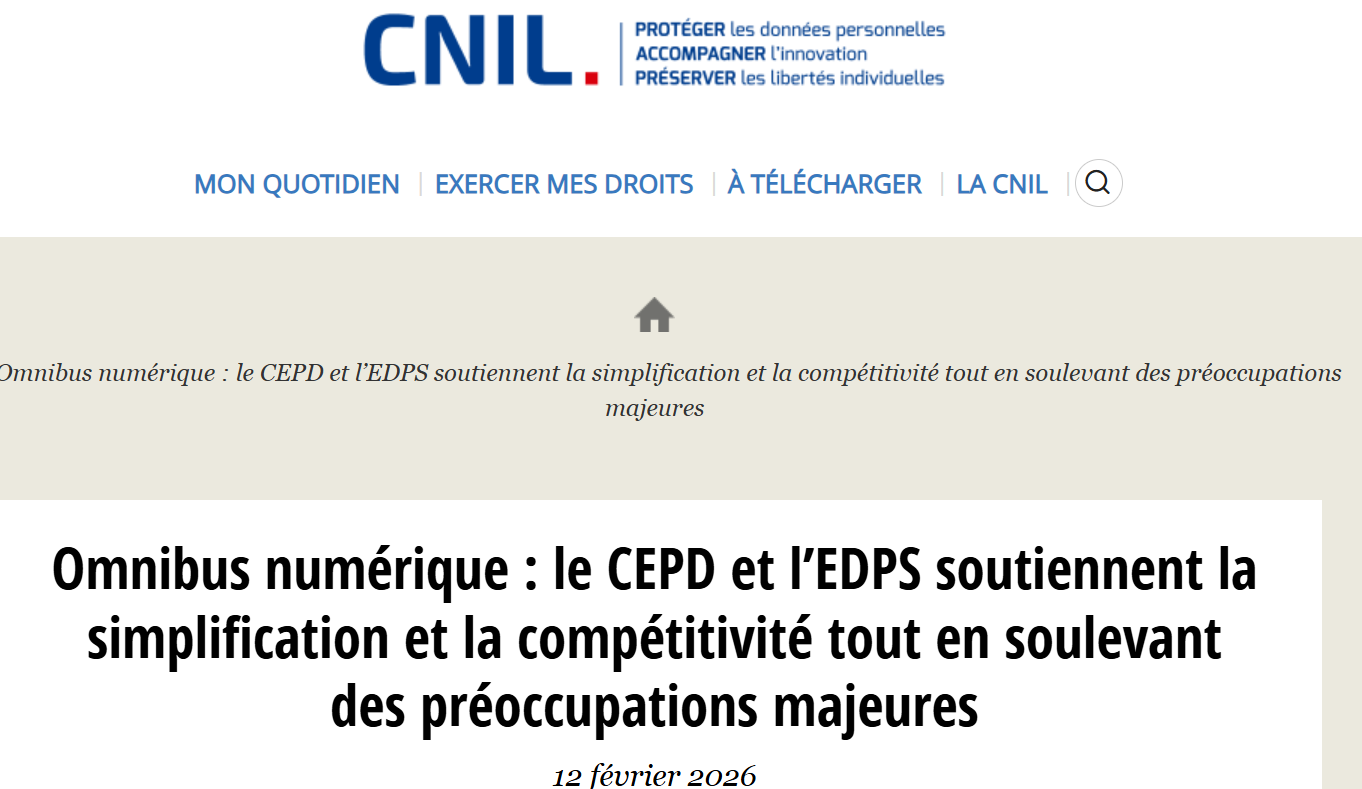
As noticed by the European Data Protection Board and CNIL - Commission Nationale de l'Informatique et des Libertés 3 months ago, the governance gap is real and needs to be legally addressed.
While current safety frameworks address traceability obligations at training time, none enforce authorization at runtime, per action, against user-defined policies.
Today, deployed AI agents have unrestricted API access within their technical capabilities. They can query any endpoint. Transmit any data. Interact with any system. Tomorrow, human automated policies shall prevail.
n house, you will need a Principal Authorization System (PAS) that validates every agent action against stored user policies at runtime. Not a training constraint but a runtime enforcement layer. IIt will for instance frame user’s AI assistant to share calendar contents with a third-party through such Principal Authorization System (PAS) so that their individual policy controls.
DPOs, is your team & Tech ready to frame AI agents processing of personal data with the Privacy Engineering architecture required by the Omnibus? If not, our contact form if for you.
*The EU Digital Omnibus package was formally proposed by the European Commission on 19 November 2025. Its provisions on AI were subject to provisional political agreement between the European Parliament and the EU Council under Cyprus Presidency on 7 May 2026. A formal adoption in the Official Journal is expected before 2 August 2026.
The "other part" of the digital package introduces a structural reconfiguration of consent rules set in article 6(1)(a) #GDPR directly relevant to AI agent deployments. With the Digital Omnibus, consent requirements for AI will tighten significantly so that agents do not rely on implied permission anymore.
As noticed by the European Data Protection Board and CNIL - Commission Nationale de l'Informatique et des Libertés 3 months ago, the governance gap is real and needs to be legally addressed.